1 From a Question to a Measure
Where this chapter fits. Step 1 of the research process is to formulate the problem. The Introduction describes all eight steps. This chapter takes the research question from step 1 and defines each term in it so that it can be measured.
1.1 One Night in January
On one night in the last ten days of each January, volunteers and outreach workers across the United States count people who are homeless. They visit shelters. They also walk through parks, check cars and campgrounds, and look under bridges. The US Department of Housing and Urban Development, known as HUD, collects the local totals and reports a national number to Congress. This is the point-in-time count.
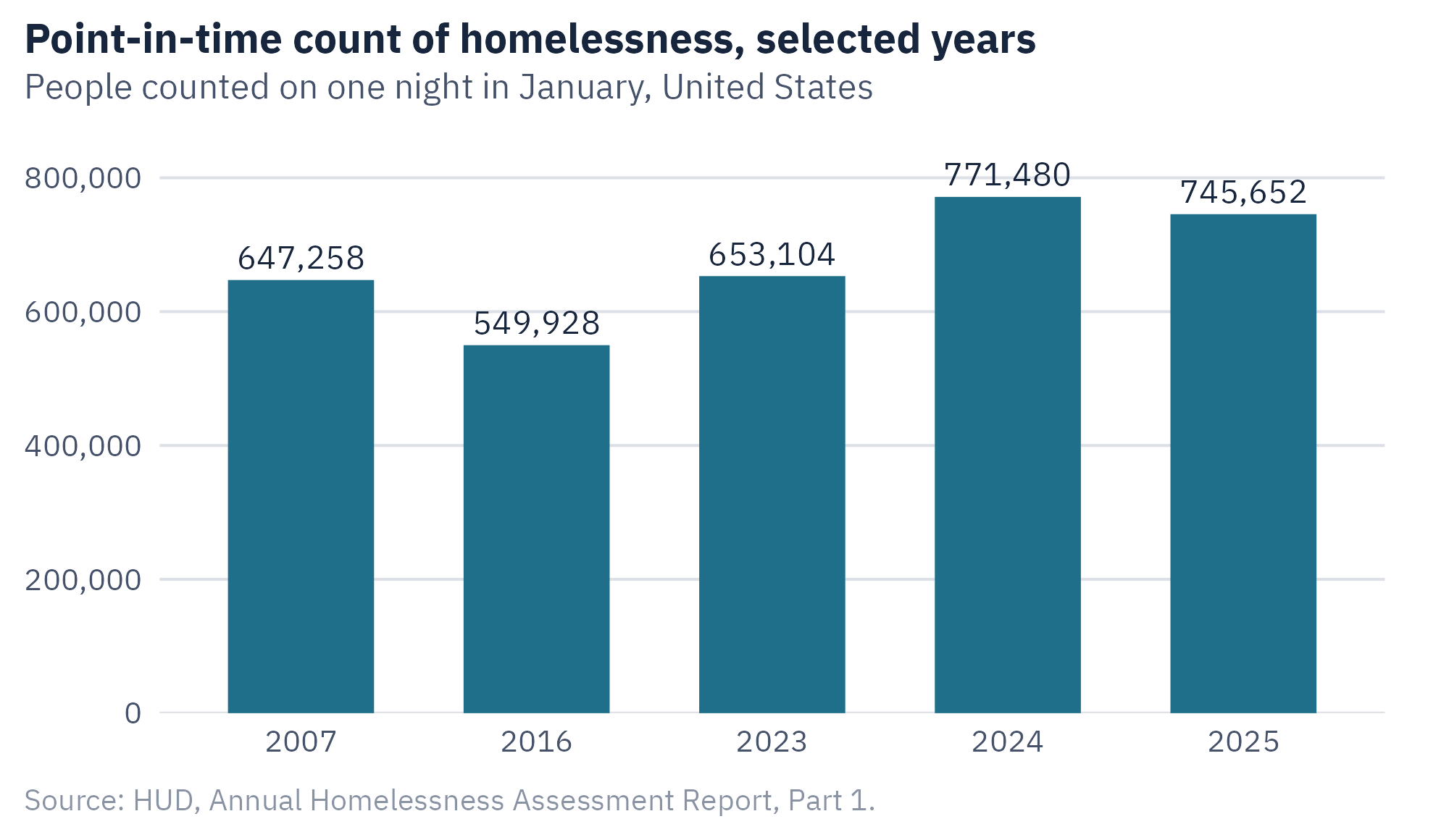
The count for January 2024 was 771,480 people. It was the highest total since the counts began in 2007. The count for January 2025 was 745,652. Figure 1.1 shows five of the annual totals.
Most news reports treat this number as the number of homeless people in the country. It is a narrower figure than that. It is the number of people who met one definition, in the places that were searched, on one night. A second federal count uses a second definition and gives a larger total. Public schools report the number of enrolled students who lack a fixed, regular, and adequate place to sleep at night. The school count includes children whose families have moved in with relatives or friends after losing their housing. The HUD count leaves those children out. In recent school years, the school count has been above 1 million students.
Neither count is wrong. They answer different questions. A researcher who wants to study homelessness has to decide which question to ask before any counting begins. This chapter is about that decision.
1.2 Start With the Decision
A study begins with a problem that someone needs to act on. A city council may need to decide how many shelter beds to fund. A school district may need to decide how many staff to assign to students without stable housing. A foundation may need to decide whether a housing program worked.
Each of those decisions needs a different number. The council needs to know how many people need a bed on a cold night. The district needs to know how many students lack stable housing during the school year. The foundation needs to know how many people in the program were housed a year later.
A research question states what the study will find out. A good research question names three things.
- The population. Who or what the study is about.
- The concept. What the study will measure or compare.
- The time and place. When and where the answer applies.
“How many people are homeless?” names none of the three with enough detail to act on. “How many people in the county slept in a shelter or outdoors on the night of January 28?” names all three. The second question can be answered. The first one cannot be answered until someone makes it more specific.
A Test for a Research Question
Ask what you would do if the answer were high and what you would do if it were low. If the two actions are the same, the question does not help with the decision. Rewrite it until the answer would change what someone does.
1.3 Concepts and Definitions
“Homelessness” is a construct. A construct is an idea that cannot be observed directly. Poverty, health, satisfaction, and intelligence are constructs. A researcher can observe where a person slept last night. A researcher cannot observe “homelessness” without first deciding what the word covers.
That decision has two steps.
The first step is the conceptual definition. It states in words what the construct means. Federal law defines a homeless person as someone who lacks a fixed, regular, and adequate nighttime residence. That sentence is a conceptual definition. It is clear enough to discuss and too general to count with.
The second step is the operational definition. It states the procedure that will be used to decide whether a case fits. HUD’s operational definition has two parts. A person is counted as sheltered if the person is staying in an emergency shelter, a transitional housing program, or a safe haven. A person is counted as unsheltered if the person is sleeping in a place that is not meant for living. Examples are a car, a park, and an abandoned building.
The operational definition is what produces the number. Two studies can share a conceptual definition and still report different results if their procedures differ.
Table 1.1 compares three operational definitions of homelessness that federal agencies use.
| HUD point-in-time count | HUD annual shelter estimate | Public school count | |
|---|---|---|---|
| Who is counted | People in shelters and people sleeping in places not meant for living | People who used a shelter program | Enrolled students without a fixed, regular, and adequate place to sleep |
| Includes families staying with others | No | No | Yes |
| Includes people sleeping outdoors | Yes | No | Yes |
| Time covered | One night in January | Any time in one year | Any time in one school year |
| Who collects it | Local planning groups, with volunteers | Shelter record systems | School district staff |
Each column is a reasonable way to count. Each one also leaves people out. The point-in-time count leaves out families staying with relatives. The shelter estimate leaves out people who never enter a shelter. The school count leaves out adults and children who are not enrolled.
1.4 A Count on One Night and a Count Over a Year
The point-in-time count and the annual shelter estimate differ in a second way. One covers a single night and the other covers a year.
A count at one moment is a point-in-time measure. It shows how many people are in a condition at that moment. A count over an interval is a period measure. It shows how many people were in the condition at any time during the interval.
The two can differ by a large amount. Suppose a shelter has 100 beds and every bed is full every night. A count on any single night finds 100 people. If the average stay is one month, about 1,200 different people use the shelter in a year. Both numbers are correct. The one-night count describes how much capacity the shelter needs. The annual count describes how many people the problem reaches.
A one-night count also contains a higher share of people with long stays. A person who is homeless all year is present on every night of the year. A person who is homeless for two weeks is present on only 14 of the 365 nights. A count on one night is therefore more likely to include the first person than the second. A reader who uses a one-night count to describe “the typical homeless person” will describe long stays as more common than they are.
1.5 Work With the Data: One Night or One Year
The shelter example above used one length of stay. The tool lets you change the stays and see both counts at once. It models a shelter that is full every night.
Open One Night or One Year in its own window
- Leave the shelter at 100 beds. Read the two counts. The one-night count equals the number of beds.
- Set the share of beds used by people with long stays to 50 percent. On one night, half the people counted have long stays. Compare that with the count over the year.
- Shorten the short stay to 7 days. The count over the year rises. The one-night count does not change.
- Set the long-stay share to 0 percent, then to 100 percent. Note which count moves.
The one-night count depends only on the number of beds. The count over the year depends on how long people stay. This is why the two federal counts in this chapter can both be correct and still differ by hundreds of thousands.
The counts used in this chapter are in the file ch01-pit-counts.csv at quant.marginoferrormedia.com/data.
1.6 Variables, Units, and Levels of Measurement
Once the definition is set, the study records it as a variable. A variable is a characteristic that can take different values for different cases. Housing status on the night of the count is a variable. Its values are sheltered and unsheltered.
The unit of analysis is the thing each row of the dataset describes. In the point-in-time count, the unit is a person. HUD also reports results by household and by local area. A researcher has to choose the unit before collecting data, because a file of people cannot always be turned into a file of households later.
Variables differ in how much information their values hold. The standard classification has four levels of measurement.
- Nominal. The values are names with no order. Sheltered and unsheltered are nominal. So are the names of states.
- Ordinal. The values have an order, and the distances between them are unknown. “Less than a month, one to six months, more than six months” is ordinal.
- Interval. The values have equal distances and no true zero. Temperature in degrees Fahrenheit is the usual example.
- Ratio. The values have equal distances and a true zero. The number of nights a person spent in a shelter is a ratio variable.
The level of measurement limits what can be calculated. A mean requires interval or ratio data. A median requires at least ordinal data. Nominal data can only be counted. Collect each variable at the highest level that is practical. A researcher who records the exact number of nights can group the values later. A researcher who records only “short” or “long” cannot recover the exact number.
1.7 How the Procedure Shapes the Number
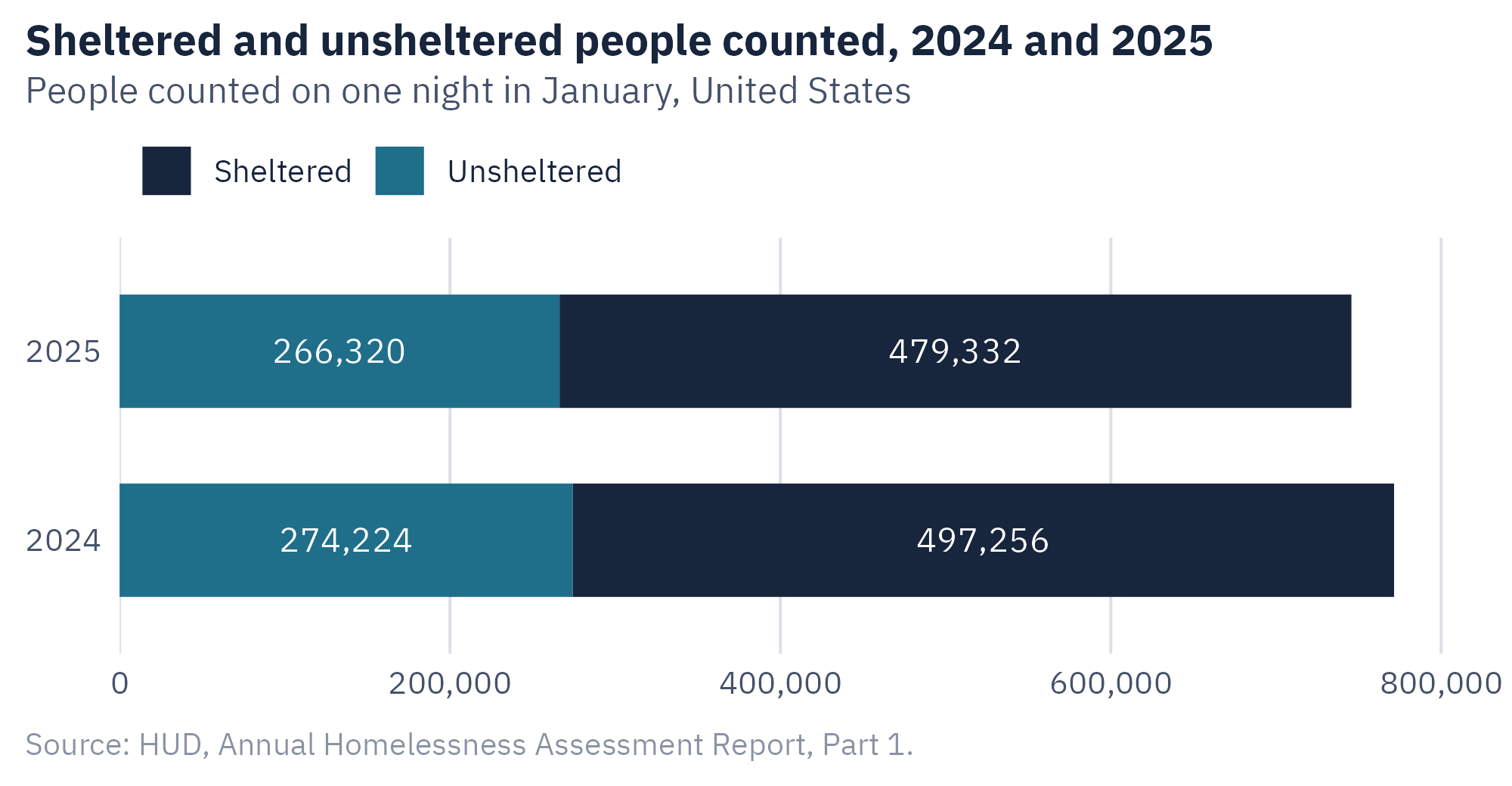
Figure 1.2 divides the two most recent counts into their two parts. The two parts are collected in different ways, and they are not equally accurate.
The sheltered count comes from records. Shelters know who slept there. The unsheltered count comes from a search. Volunteers have a few hours to find people who may not want to be found. HUD’s own report says the true number of unsheltered people could be larger than the number reported.
The procedure also varies from place to place. HUD requires a sheltered count every year and an unsheltered count every second year. Most local areas conduct both every year. In 2024, 22 of almost 400 local areas did not conduct an unsheltered count. In 2025, 29 did not. In 2021, during the pandemic, only the sheltered count took place. A change in the national total can therefore have two causes. One is a change in the number of people. The other is a change in the procedure.
These details are part of the operational definition. A reader who knows them can use the number well. The count is a reasonable guide to how many shelter beds are in use. It is a weaker guide to how many people sleep outdoors. It gives no information about families who are staying with relatives.
A measure that stands in for a construct it does not fully capture is a proxy. Every count in Table 1.1 is a proxy for homelessness. The useful question is which part of the construct each proxy captures and which part it leaves out.
Ethics Moment: A Definition Decides Who Gets Help
Federal housing funds are distributed in part by the point-in-time count. A family that has moved in with relatives does not meet HUD’s definition and is not counted. That family is also not eligible for some programs that the count helps to fund. A definition can therefore be an eligibility rule as well as a research choice. Before you adopt a definition, list who it leaves out. Then ask whether those people would agree that they are outside the problem you are studying.
AI Reality Check: Ask Which Definition
A language model will define “homelessness” in a clear sentence if you ask. It will usually not tell you which agency’s definition it used, and it may combine two of them. The same is true for poverty, unemployment, and food insecurity. Each has more than one official definition. Ask the model to name the source of the definition and the procedure used to count. Then read the source. A fluent sentence is not evidence that the definition matches the number you plan to cite.
1.8 Putting It All Together
A research question names a population, a concept, and a time and place. The concept is usually a construct that cannot be observed directly. A conceptual definition states what the construct means. An operational definition states the procedure for deciding whether a case fits, and the procedure is what produces the number.
The homelessness counts show how much the procedure matters. HUD’s one-night count, its annual shelter estimate, and the public school count all measure homelessness. They cover different people over different lengths of time, and their totals differ by hundreds of thousands. None of them can be used well without knowing how it was collected.
1.9 Looking Ahead
This chapter treated each count as if it measured its own definition accurately. Chapter 2 drops that assumption. It uses four estimates of one population to show how a survey number can differ from the truth. It gives each kind of error a name.
1.10 Further Reading and References
- US Department of Housing and Urban Development (2024). The 2024 Annual Homelessness Assessment Report to Congress, Part 1: Point-in-Time Estimates of Homelessness. The source for the 2024 count and for the description of how the count is conducted.
- Perl, L. (2026). Homelessness. Congressional Research Service, In Focus IF12985. A two-page summary of the counts from 2007 to 2025 and of the federal definition.
- Babbie, E. (2020). The Practice of Social Research (15th ed.). Cengage. Chapter 5 covers conceptual and operational definitions in more depth.
- Stevens, S. S. (1946). On the theory of scales of measurement. Science, 103(2684), 677 to 680. The original statement of the four levels of measurement.
1.11 Key Terms
- Conceptual definition. A statement in words of what a construct means.
- Construct. An idea that cannot be observed directly, such as homelessness or health.
- Levels of measurement. Nominal, ordinal, interval, and ratio. The level limits which statistics can be calculated.
- Operational definition. The procedure used to decide whether a case fits a construct.
- Period measure. A count of cases in a condition at any time during an interval.
- Point-in-time count. HUD’s count of people who are homeless on one night in January.
- Point-in-time measure. A count of cases in a condition at one moment.
- Proxy. A measure that stands in for a construct it does not fully capture.
- Research question. A statement of what a study will find out, naming the population, the concept, and the time and place.
- Unit of analysis. The thing that each row of a dataset describes.
- Variable. A characteristic that can take different values for different cases.
1.12 Exercises
Check Your Understanding
- State the difference between a conceptual definition and an operational definition. Give one example of each for “unemployment.”
- A shelter has 60 beds, all full each night, and the average stay is two months. About how many different people use it in a year? Which number would you give a fire inspector, and which would you give a funder?
- Name the level of measurement for each variable. (a) Zip code. (b) Number of nights in a shelter. (c) Self-rated health on a scale of poor, fair, good, very good, and excellent. (d) Year of birth.
- Explain why a one-night count includes a higher share of people with long stays than an annual count does.
Apply It
- Use the file
ch01-pit-counts.csv. Calculate the percent change in the total from 2016 to 2024 and from 2024 to 2025. Show each step. - Rewrite this question so that it names a population, a concept, and a time and place. “Is hunger a problem for college students?”
- Write an operational definition of “regular exercise” that a survey could use. Then write a second one that would give a higher count. State which decision each would suit.
Think Deeper
- A city reports that its unsheltered count fell by 20 percent in one year. List three explanations that involve the procedure and no change in the number of people. What would you ask the city before you repeated the result?
- The school count includes families staying with relatives, and the HUD count does not. Argue for each choice. Which would you use to plan shelter capacity, and which to plan school services?
- Choose a number you have seen in the news this month. Find the operational definition behind it. Describe one group the definition leaves out.